Can a Foreign Brand Launch on Makuake? 6 Requirements Overseas Manufacturers Must Meet
2026/9/20
Can a Foreign Brand Launch on Makuake? 6 Requirements Overseas Manufacturers Must Meet
Yes, with a partner in Japan. Needs Japanese ops, Japan-only shipping, certification. Importer/customs work can't be done from abroad.
If you make a physical product outside Japan, Makuake is the main way to test the Japanese market before shipping stock into it. It is also the route with the most requirements. This guide lists all six, shows where each is published, and says who handles it. Last checked: September 2026.
Why do overseas manufacturers launch in Japan through crowdfunding?
Japanese crowdfunding is a pre-order, not a pledge
It's a pre-order, so a late delivery reads as failure.
The category is called 応援購入 (ōen kōnyū), or "supportive purchase." In practice it is a pre-order. A three-month delay reads as part of the adventure on Kickstarter. In Japan it reads as a seller failing to deliver what was sold. It stays in the public comment thread under your project permanently.
A campaign breaks the "no Japanese sales record" deadlock
A campaign creates the sales record retailers require.
Japanese retailers, EC platforms and wholesalers want proof that a product already sells in Japan before they open a trading account. You cannot get that proof without being on sale. A campaign is the entry point that breaks the loop before you own any Japanese inventory. It leaves you with three assets:
- A real sales record. Units sold in yen to Japanese customers, with names and shipping addresses attached.
- Japanese content and voices. A Japanese product page, Japan-directed photography and video, and customer reviews you can quote later.
- A compliance and fulfillment trail. Certification on file, labeling done, and orders shipped and supported from inside Japan.
What does Makuake require from an overseas project owner?
All six requirements below come from Makuake's published rules and Japanese statutes. Sources are listed at the end of this article.
Group A: three requirements about who does the work
Everything runs in Japanese; rewards ship only in Japan.
- The project page is edited and managed in Japanese. This covers the application, review questions, requested revisions and every live update.
- Customer communication is handled in Japanese. That means answering the public comment thread daily while the campaign is live, and for months after it closes. A staff member who speaks some Japanese is not enough.
- Reward delivery is limited to within Japan. You cannot ship direct from overseas to each buyer. Stock must land in Japan, and something in Japan must dispatch it. (Source: Makuake Help Center.)
Group B: three requirements about who you are legally
Certification, imports and customs need a Japan resident.
- Japanese certifications must be obtained or scheduled. Radio-emitting products need Technical Conformity certification (技適 / TELEC) under the Radio Act (電波法). AC-powered products and lithium batteries need PSE marking under the Electrical Appliance and Material Safety Act (電気用品安全法, "DENAN").
- The DENAN obligation sits with the manufacturer or importer. METI ties the start of an import business to the date goods enter Japan. A company outside Japan is not the party bringing them in, so someone inside Japan must be.
- A non-resident importer must appoint a Customs Administrative Manager (税関事務管理人). Article 95 of the Customs Act requires a person or company resident in Japan. Since 1 October 2023, the filing must also state the relationship between the importer and the manager.
The floor under all six: an owner of record and a Japanese address
You need a Japanese bank account, address and phone number.
- A project owner of record. The owner needs a bank account at a Japanese bank, held in that name.
- Seller disclosure. The Act on Specified Commercial Transactions (特定商取引法) requires a business name, an address in Japan and a phone number in Japan on the page where the product is sold. An overseas address or number does not satisfy it.
Makuake review runs in three passes: does the business exist, can the product be delivered, and is it legal to sell in Japan. Budget several weeks and expect questions in Japanese at each pass.
Who handles each of the six requirements?
The six requirements are one question: who, inside Japan, is answerable for this product?
That party is what people mean by "a partner in Japan." SOMA handles the Japanese-language work directly. The certification work is shared with your engineers. Structure items are designed per project.
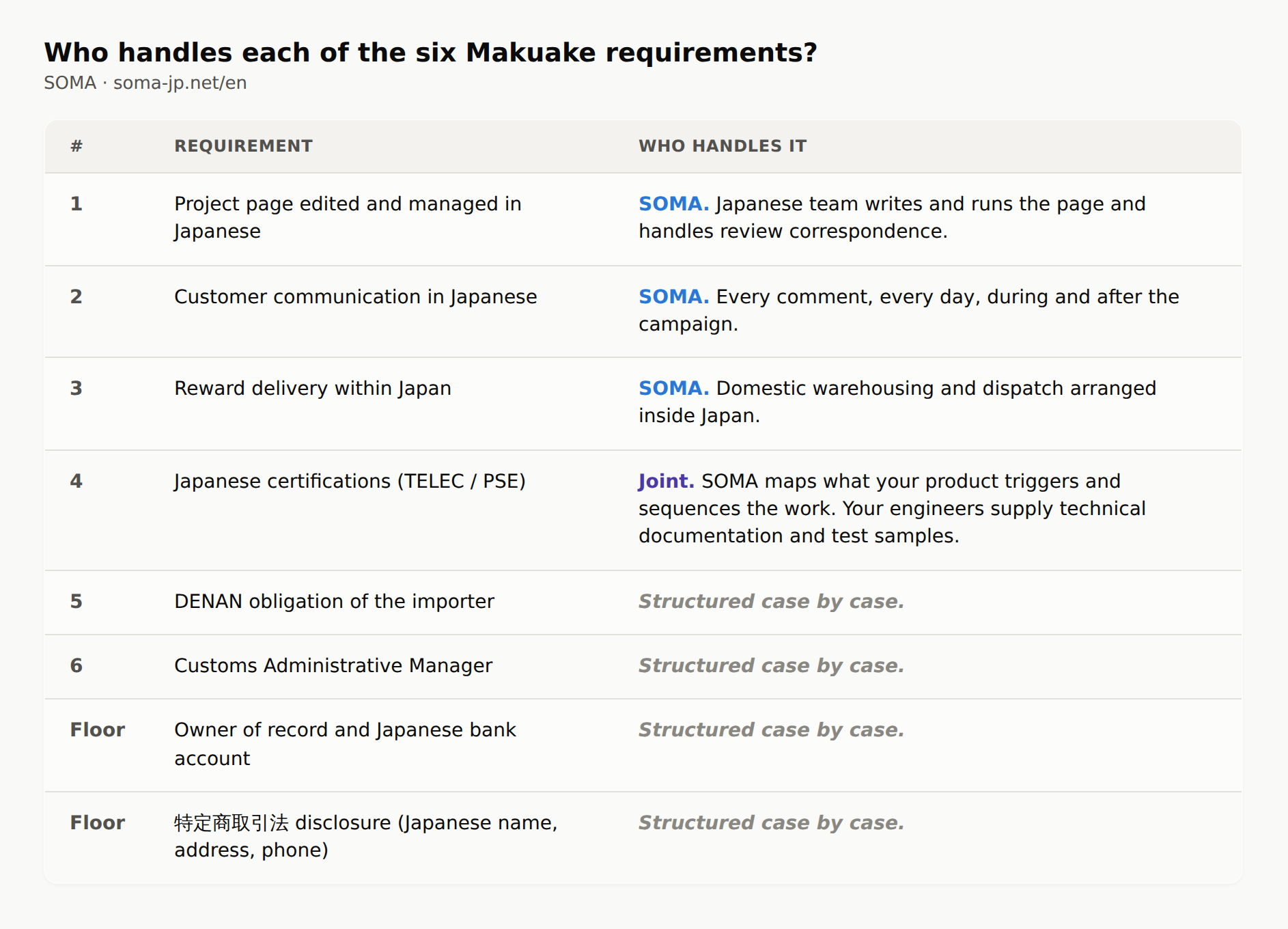
The last four rows have no single answer. The right structure depends on your product, the certifications involved and what you already have in place. If something is not realistic for your product, you hear it at the eligibility check, before you commit to anything.
Which products can go to Japan first?
Regulation follows product category, and category is the first fork in the road.
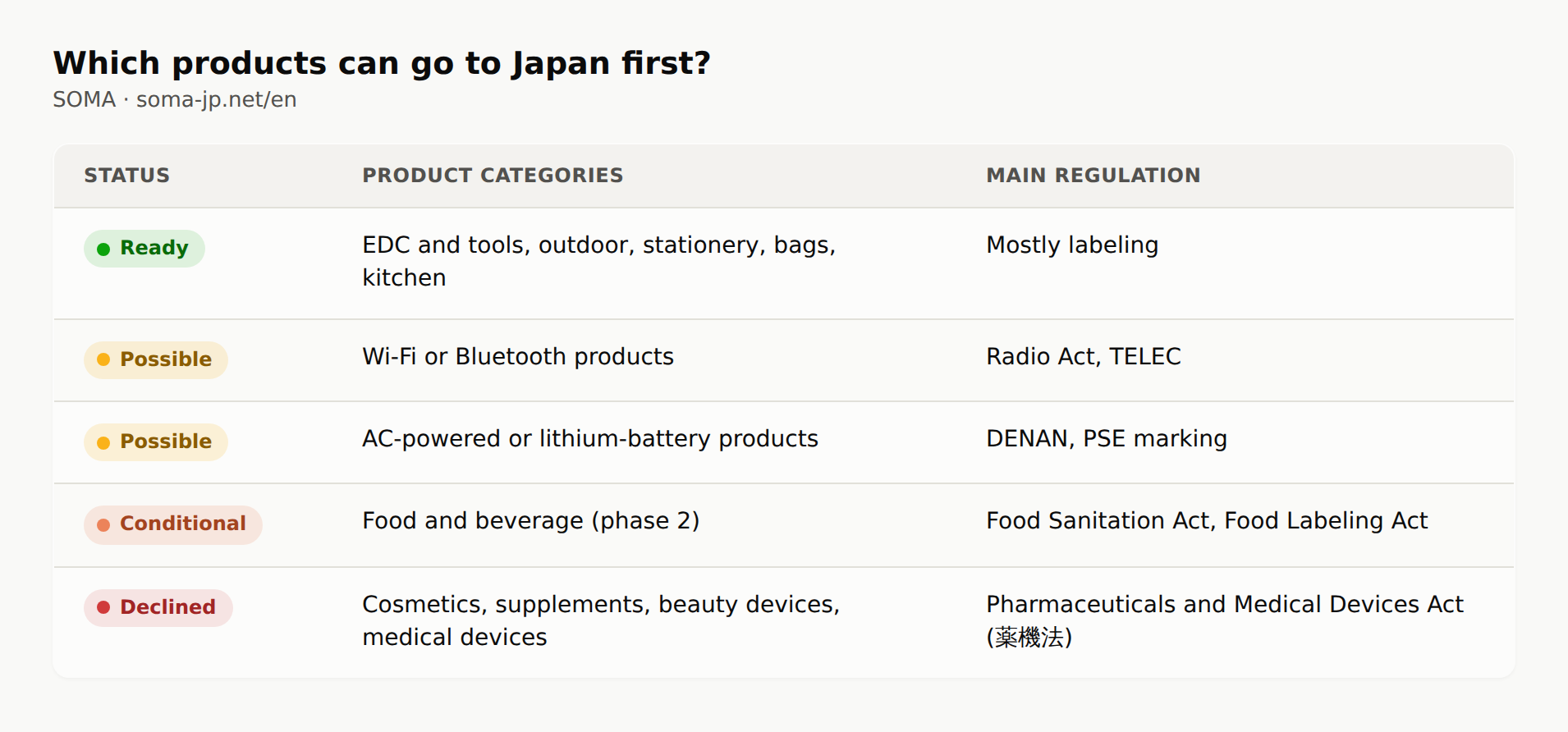
Certified products often sit at higher price points. Build the schedule backwards from certification lead time, not forwards from your launch date.
Four more rules apply to every product:
- Act against Unjustifiable Premiums and Misleading Representations (景品表示法). A struck-through "regular price" needs a reasonable basis.
- Stealth marketing rules (ステマ規制). In force since October 2023. Paid or incentivized posts must be labeled as advertising.
- Product Liability Act (製造物責任法). The importer carries the same liability as the manufacturer.
- Trademark. Japan awards rights to the first to file, not the first to use.
Trademark: file before you launch
Japan grants trademark rights to whoever files first.
If a campaign shows your brand to Japanese buyers and someone else files it, you may be unable to sell under your own name. Buying it back is the expensive version of this problem. Do this whether or not you ever launch in Japan.
Makuake, CAMPFIRE or GREEN FUNDING: which platform fits an overseas brand?
The three platforms do not accept the same things on the same terms.
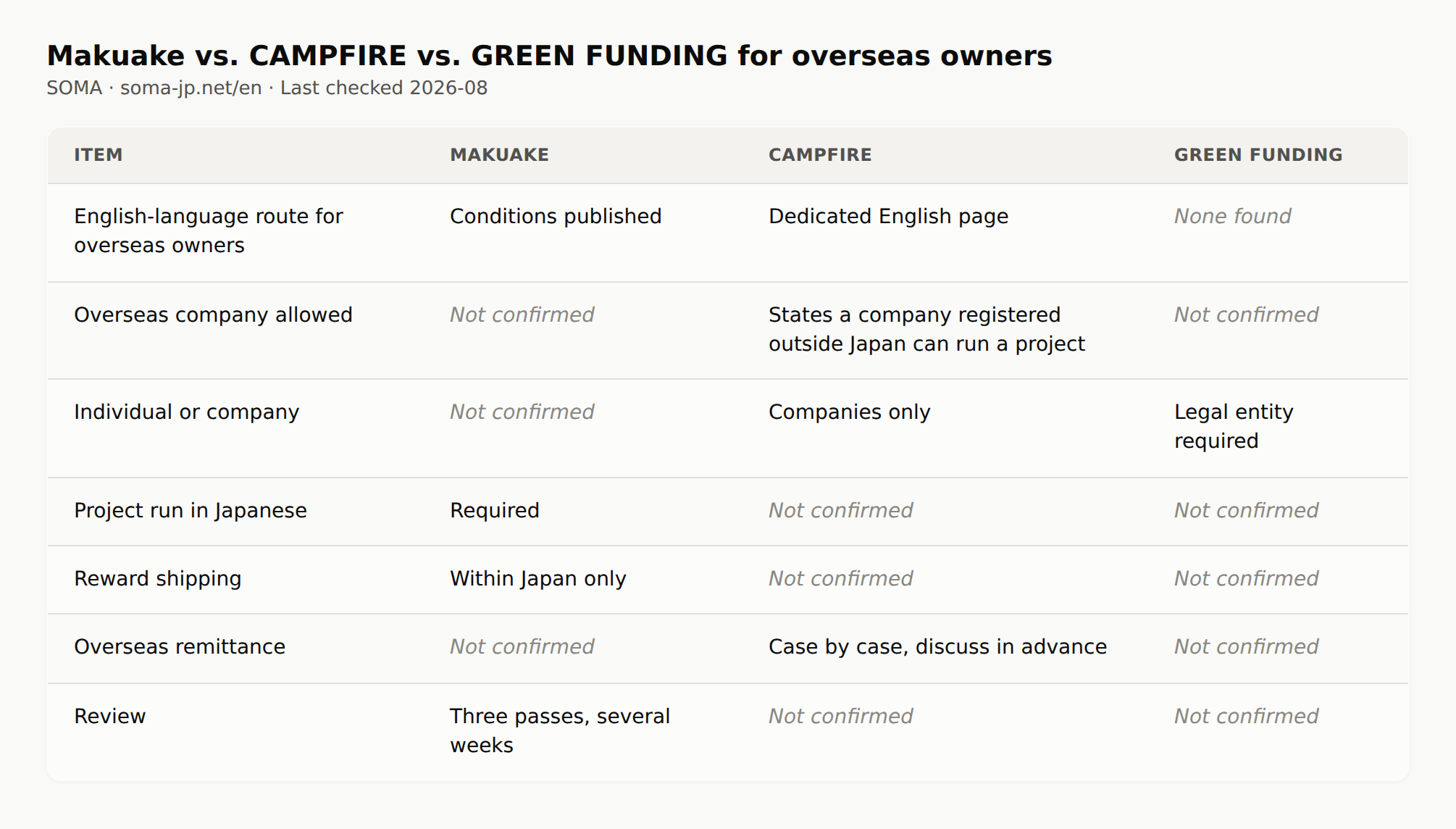
"Not confirmed" means the condition could not be verified from a primary source as of August 2026. Platform terms change, so check each platform's own site before you decide.
The choice is not simply CAMPFIRE to test and Makuake to scale. It depends on the product and on what you want the campaign to prove. Whichever you pick, the three Group B requirements remain. Choosing a platform sets operating terms. It does not remove the law.
How does a Japan launch work, step by step?
A Japan launch takes six steps, and only the first has a fixed one-day clock.
- Eligibility check (1 business day). You send a product page, spec sheet or campaign link. You get a written read on category, regulation and fit. Sometimes the answer is no.
- Product and platform decision (depends on the product). Choose the first SKU, the platform, the campaign goal, and a Japan-side price built for the local market rather than converted from USD.
- Certification and structure (depends on the product). Map the certifications, then design who stands where for requirements 5 and 6 and the floor items.
- Page and assets (depends on the product). The page is written in Japanese from the product up, not translated. Photography and video are directed for a Japanese buyer. The application goes in and review begins.
- Live campaign (for the full run). Launch timing, PR, paid distribution, updates, and the daily Japanese comment thread.
- After the campaign (depends on the result). Use the sales record, Japanese assets and compliance trail to open talks with retailers, EC platforms and distributors.
Frequently asked questions
Do I need a Japanese company to launch on Makuake?
Not to start, and not in every case.
The platforms do not require the applicant to be a Japanese corporation as such. They require Japanese-language operation, Japan-only reward shipping, and a seller disclosure with a Japanese name, address and phone number. Some of that can be met without incorporating. Some depends on the product, especially where certification or importing is involved.
Do I need a Japanese bank account?
The owner of record needs a Japanese bank account.
Who acts as owner of record is designed per project. It depends on your product and what you already have in place in Japan.
Do I have to speak Japanese?
No — the Japanese-language work is done for you.
SOMA writes and runs the project page, handles review correspondence and answers every buyer comment. SOMA's CEO, Takuma Naito, handles overseas clients directly in English.
Who obtains the TELEC and PSE certifications?
It's joint: SOMA maps it; engineers supply the data.
SOMA identifies what your product triggers and orders the steps. Technical documentation and test samples come from your engineers. The importer-side DENAN obligation is structured case by case.
What is a Customs Administrative Manager, and do I need one?
A Japan-resident manager a non-resident importer must name.
Article 95 of the Customs Act requires this for non-residents carrying out customs procedures in Japan. If your goods enter Japan under your own name as importer, the appointment applies to you. SOMA structures this per project.
What if my product is not a fit?
You hear it at the eligibility check, before committing.
Cosmetics, supplements, beauty devices and medical devices are declined in phase 1. For other products, SOMA gives a straight read on whether the product should go to Japan at all.
What should you do next?
Send SOMA your product page and get a written eligibility read within one business day.
SOMA has run more than 100 crowdfunding campaigns on overseas platforms, including Kickstarter, Indiegogo and ZecZec. Eight are still live on Kickstarter, so you can check them yourself. SOMA Inc. is a real company in Yokohama, founded on September 9, 2019.
- We reply within one business day (JST).
- We work in English.
- No sales call.
Start the free Japan launch eligibility check →
Learn more about the requirements, platforms and process on the SOMA overseas-brand page.
Sources